When Trends Ignore the Law: ADA Effective Communication Goes Beyond Digital Accessibility

Right now, many organizations are chasing the newest compliance trend: digital accessibility.
And to be clear, they should.
Websites, mobile apps, PDFs, portals, and online forms need to be accessible. Web Content Accessibility Guidelines (WCAG) compliance matters. Digital access matters. The Department of Justice’s (DOJ) updated Americans with Disabilities Act (ADA) Title II rule has made digital accessibility even more urgent for state and local governments. Organizations should review their digital content, fix inaccessible forms, remediate documents, and build accessibility into their technology.
But here is the problem:
Some organizations treat digital accessibility as the whole picture. It is not.
Effective Communication is an ADA Requirement
Long before digital accessibility became the hot topic, the ADA already required covered entities to communicate effectively with people with disabilities. That requirement did not start with WCAG. It did not start with Diversity, Equity, and Inclusion (DEI). It did not start with a new trend, a lawsuit, or a website audit.
It has been part of the Americans with Disabilities Act since 1990.
What Does ADA Effective Communication Require?
The ADA is a civil rights law. It protects people with disabilities from discrimination in many areas of public life. Under the ADA’s effective communication requirements, covered entities must ensure that communication for people with disabilities is as effective as communication for people without disabilities. The DOJ explains this through the requirement to provide appropriate auxiliary aids and services when needed.
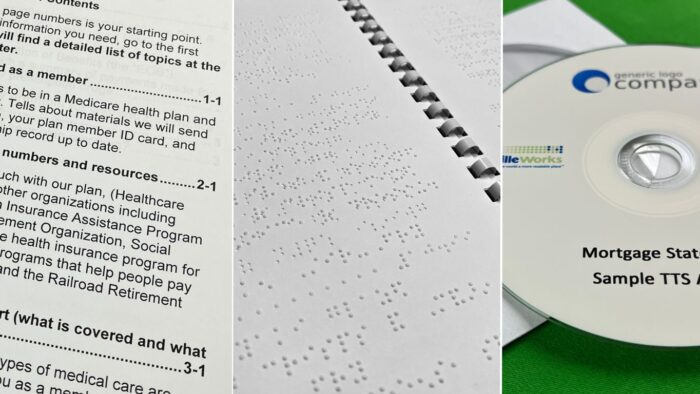
For people who are blind, have low vision, have print disabilities, or cannot access standard print, effective communication may include braille, large print, audio, accessible electronic documents, qualified readers, or other formats that allow the person to access the same information.
That means basic client-facing communication should not stop at “we have a website.”
Which Documents Should Be Available in Accessible Formats?
If your organization has standard forms, notices, applications, instructions, disclosures, bills, patient forms, consent forms, policies, or other routine documents, those materials should be available in accessible formats. Braille, large print, audio, and accessible PDFs are not extras. They are part of the foundation of effective communication.
For standard documents, organizations should prepare before the request comes in. For specialized, unique, or one-time documents, organizations should have a clear process to provide accessible formats upon request.
What Should You Do When Someone Requests an Accessible Format?
What should not happen is a client, patient, student, customer, or resident asking for an accessible format and being told:
- “We don’t do that.”
- “We don’t have the resources.”
- “We can email you the regular PDF.”
- “You can have someone read it to you.”
- “That is not something we offer.”
These answers are not solutions. They are barriers.
They are also not legal defenses.
Staff should know where to send the request, how to document the person’s needs, and who is responsible for providing the accessible version. The process should be clear to both the employee and the person making the request.
The ADA does not allow an organization to avoid effective communication because it failed to plan, budget, or train its staff. If a person with a disability needs information in an accessible format, the organization should take that request seriously, respond appropriately, and provide a format that works for that individual.
This is not just about checking a compliance box. It is about whether people can understand their rights, complete forms independently, make informed decisions, access services, manage their accounts, participate in programs, and receive the same information as everyone else.
It is also smart business.
Accessibility Also Reaches a Significant Market
The Valuable 500 estimates that people with disabilities represent $8 trillion in annual disposable income globally. When friends and family are included, that estimate grows to $13 trillion.
That is not a small audience. That is a major part of the global market.
When organizations ignore accessible communication, they are not only increasing legal risk. They are excluding clients, customers, patients, and community members who want to engage, purchase, participate, and belong.
How to Build an Effective Communication Process
This is where preparation matters.
Organizations do not need to wait for a complaint to do the right thing. They can start by reviewing their most common documents, identifying which materials clients rely on most, creating accessible-format procedures, training frontline staff, and ensuring requests are handled with respect rather than resistance.

How Braille Works Supports ADA Effective Communication
At Braille Works, we help organizations provide accessible formats that support effective communication, including braille, large print, audio, accessible PDFs, and document remediation. We work with organizations that need to make their standard documents accessible and with teams that need a reliable process for handling requests when unique or specialized documents come in.
We also understand that accessibility is not only about production. It is about knowing what the law requires, what your clients need, and how to build a process that works.
In addition to accessible document services, Braille Works offers consultation support with a Certified Accessibility Coordinator. That means organizations do not have to guess their way through ADA communication responsibilities. They can review their current process, identify gaps, understand common barriers, and create a practical plan for responding to accessibility requests with confidence and respect.
Digital accessibility deserves attention, but the responsibility reaches further. Accessible communication is a civil rights obligation that applies across documents, services, programs, and everyday interactions.
Equal Access Should Not Begin with a Complaint
Effective communication is still one of the clearest, most practical ways for an organization to demonstrate that it understands both the law and the people it serves.
Remember, when someone asks for braille, large print, audio, an accessible PDF, or another accessible format, they are not asking for special treatment.
They are asking for equal access.