Another Tool in the Toolbox: AI, Accessibility, and the Right to Privacy

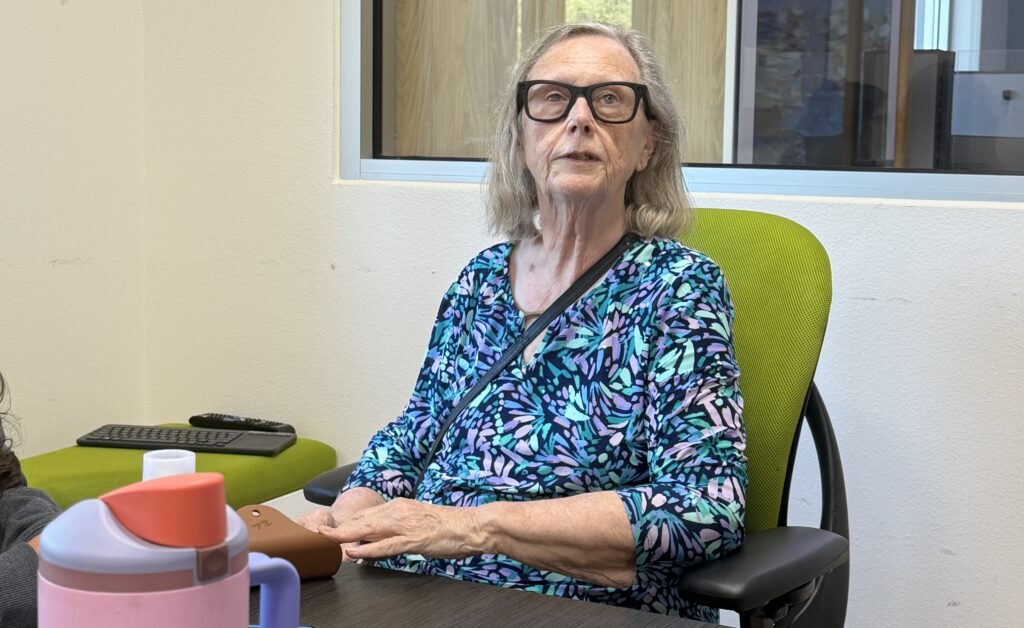
I recently had the pleasure of attending a training at Dogs Inc., where Shirley Tracy learned how to use her new Meta Ray-Ban AI glasses.
I went into the training interested in the technology and its potential for people who are blind or have low vision. I left thinking about something much bigger. AI can be an incredible accessibility tool. But it is still a tool.
As organizations increasingly look to AI for convenience and cost-effectiveness, we need to be careful not to confuse access through AI with providing accessible information. Especially when that information is private, financial, medical, or otherwise sensitive.
Independence Came Long Before AI
To understand what these glasses mean for Shirley, it helps to understand a little about her.
Shirley has always been extremely independent. She grew up with low vision and was never able to drive. She eventually lost her remaining vision following complications associated with cataract surgery and glaucoma.
Blindness changed how she did things, but it didn’t stop her from doing them.
As a young woman, she water-skied and spent time with friends. She attended college and graduate school, raised three children, and worked. Later, after remarrying, she was able to devote herself more fully to something she loves, writing. Her work has appeared in many magazines; she remains active in a writing group, and she eventually self-published a book for middle-school readers.
Guide dogs have also been an important part of that independence.
Shirley has had nine guide dogs. Her current dog, Eddy, came from Dogs Inc. in Palmetto, Florida, formerly known as Southeastern Guide Dogs. Eddy followed Jack, another Dogs Inc. dog who is now retired.
Thanks to a donor’s generosity, Dogs Inc. has been able to provide Meta glasses at no cost to former students who are currently working with one of their dogs. That generosity gave Shirley the opportunity to receive not only the glasses, but individualized training on how to use them.
Throughout the training, the Dogs Inc. team emphasized an important point: the glasses are one more tool in the toolbox for someone who is blind or visually impaired.
Technology Has Always Been Part of Her Toolbox
At 80, Shirley makes a point of keeping up with technology.
She uses JAWS screen-reading software to access her computer and accessible documents. This helps her maintain her independence. She can securely review sensitive information, such as financial statements, bills, and medical information.
She uses an iPhone and its built-in accessibility features. Over the years, she has also used a talking color identifier, a device for identifying money, and technology for reading printed material and books.
She navigates software updates, changing programs, and new devices. She has taught herself much of what she knows.
Shirley actually purchased an earlier version of the Meta glasses as soon as she could. She could immediately see the possibilities, but the technology did not yet meet all of her expectations. Battery life, in particular, limited how useful they could be throughout her day.
The newer glasses are much closer to what she had hoped for. During her training, we learned the glasses provide roughly eight hours of use, depending on how they are being used, and can recharge quickly in their case. But battery life is only part of what has changed.
When Shirley put the new glasses on and began discovering what they could do, she was blown away. She said, “Hey Meta, what am I looking at?” and Meta gave her a detailed description of the items on a conference table, the people at the table, including the color of the chairs and walls, and even mentioned a bottle of probiotic water. That is descriptive and provided more details than most people would have given her.
Sometimes Independence Is Reading a Flyer
Shirley lives in an independent apartment community. Like many communities, information about activities and events is often posted on printed flyers.
“If I cannot see the flyer, I may never know that an event is happening,” Shirley shared.
One of Shirley’s first goals for the glasses was remarkably simple: she wanted to read those postings herself.
The same applies when she goes to a restaurant. She appreciates restaurants such as Outback Steakhouse, Applebee’s, and Cracker Barrel when they have an updated braille menu. A braille menu lets her browse the choices independently, rather than having someone else decide what information to read to her.
With the Meta glasses, she hopes to be able to read menu options where an accessible format is not offered. During her training, she was provided a sample print menu to look at and asked the glasses to read or describe what is there. She said something that most of us take for granted when we are dining out: “Instead of asking someone to read the menu and feeling pressure to order, I can browse the menu at my leisure, and order what I really want.”
And Sometimes Independence Is Finding Dog Poop
There were uses for the META AI glasses I had never considered.
Anyone who has a dog knows there are certain responsibilities that come with the territory. If you cannot see where your dog has relieved himself, cleanup becomes considerably more complicated.
The general rule Shirley learned for using the glasses is to point her face toward what she wants the camera to see; essentially, point your nose toward it. Thankfully, in this instance that does not mean getting your nose anywhere near the ground.
She can look down in the general direction and ask Meta whether there is dog poop. It is a funny example, but it illustrates something important about accessible technology. Some of the most meaningful applications are not dramatic. They solve ordinary problems that sighted people rarely think about.

The Safety Potential Surprised Me
I hadn’t fully considered the safety applications either.
Guide dogs are trained to stop or redirect their handlers when something makes the intended path unsafe. Eddy may know there is a problem even when Shirley doesn’t know what it is.
“There have been times when Eddy has stopped, and I am not sure why. I just have to trust him,” Shirley shared. With the glasses, she potentially has another source of information. If Eddy suddenly stops, she can look forward and ask Meta what is in front of her.
Eddy is still doing his job. The glasses do not replace his training or judgment. They may simply give Shirley more information about why he is making a particular decision, which can help reinforce trust.
That could help create another layer of communication between a guide dog and handler.
One Device Could Replace Several Others
Another benefit became increasingly obvious during the training.
People with disabilities are frequently expected to carry specialized technology to accomplish individual tasks. Shirley has accumulated devices over the years because each solves a particular problem.
The Meta glasses, combined with her phone, have the potential to consolidate several of those functions.
They can identify colors. They can assist with identifying currency. They can read printed information. They can connect with audio and other content available through her phone. They can describe objects and surroundings. They can help her access information that previously might have required a separate device—or another person.
They can even translate written language and, in certain circumstances, spoken language.
For spoken-language translation and other video functions, the glasses use a camera, and an outward-facing light indicates when video is being captured. That can understandably feel unusual to people nearby, but the potential application is fascinating.
For Shirley, the real value is not having the newest gadget. It is potentially being able to accomplish more with two things she can easily keep with her: her phone and her glasses.

Where AI Meets a Human Being
One of the features I particularly appreciated was the integration with Be My Eyes.
A user can ask the glasses to connect with Be My Eyes and receive assistance from a live volunteer who can see through the glasses’ camera and describe what is in front of the user.
There is something particularly fitting about that combination. AI provides tremendous capability, but sometimes the best solution is still another human being.
Be My Eyes brings that human element directly into the experience without requiring Shirley to find someone physically nearby to assist her. But there is an important limitation.
Users are cautioned against sharing sensitive or confidential information through volunteer assistance. The service should not be treated as a secure channel for private financial, medical, or other protected information.
And that brings me to what I believe is one of the day’s most important lessons.
Accessibility Should Not Require Giving Up Privacy
After the training, Shirley went home and started experimenting. Later that afternoon, she told me she had spent time reading her mail and cards from friends with the glasses. She loved it.
But she had already established a boundary.
She will not use Meta to read her bank statements. She will not use it for medical documents. She will not use it for information she considers private or sensitive.
She also understands that Be My Eyes is not the appropriate solution for those documents.
That is exactly where we need to be careful as enthusiasm for AI continues to grow.
A person should not have to choose between accessibility and privacy.
If I receive a private financial document in standard print, I can read it myself. I am not required to photograph it, upload it, submit it to an AI system, or allow another person to view it. A person who is blind should be afforded that same opportunity.
AI can provide an extraordinary additional means of access, but it should not become the alternative-format strategy for sensitive information that must be accessed securely. Financial institutions, healthcare organizations, government agencies, and other entities handling private information still need secure, accessible ways to communicate with people with disabilities. That may mean an accessible digital document, braille, large print, or another appropriate format based on the individual’s needs and the circumstances. The existence of AI and the amazing tools does not eliminate that responsibility.
AI Is an Accessibility Tool; Not a Replacement for Accessibility
I walked away from the Dogs Inc. training genuinely impressed with what these glasses can do.
For Shirley, they may mean independently reading the flyer hanging in her apartment community, exploring an entire restaurant menu, identifying a color, sorting money, reading a card from a friend, understanding why Eddy has stopped, or simply getting more information about the world immediately around her. Those are meaningful improvements.
They may also allow her to retire a few of the costly individual devices she has accumulated over the years and replace them with technology she can simply wear. That is exciting.
But perhaps the larger lesson is that we need to understand where AI belongs in accessibility, and where it does not.
There is a difference between using AI because someone chooses it as a convenient accessibility tool and requiring someone to use AI because accessible information was never provided in the first place.
The first expands independence. The second can force a person to trade privacy for access.
We should embrace this technology, celebrate what it can do, and keep developing innovative tools without lowering our expectations for secure, accessible communication.
My thanks to Dogs Inc., the employees who took the time to provide individualized training, and especially the generous donor who made these glasses available to Shirley and other graduates working with their guide dogs.
The technology was impressive. But one statement from the training stayed with me more than anything else: “It is another tool in the toolbox.”
For someone like Shirley, who has spent a lifetime finding the tools that allow her to live, work, write, travel, and manage her own life independently, that may be exactly where AI belongs.