Employee Spotlight: How Our Accessibility Compliance Experts Help Clients
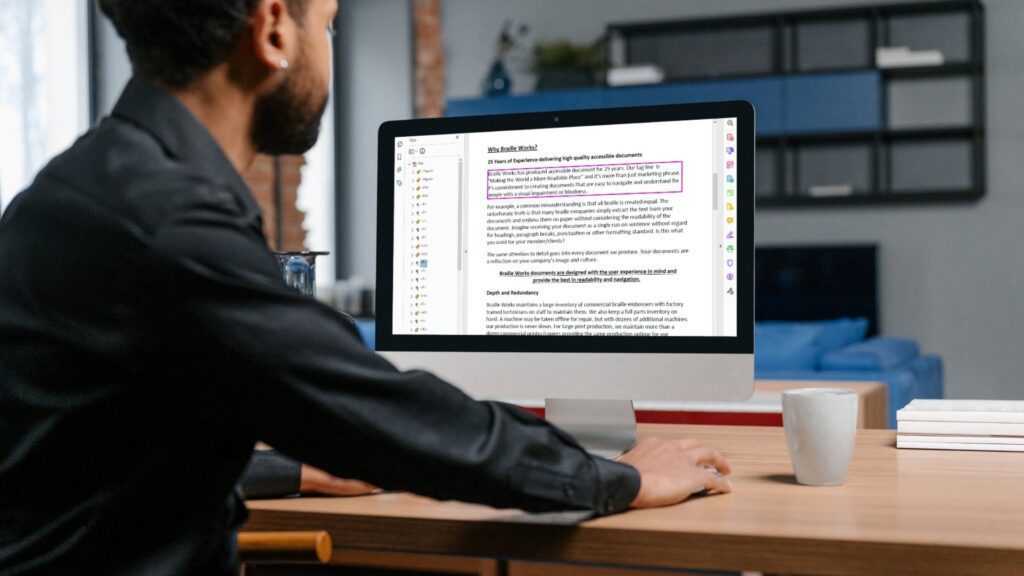
At Braille Works, our team of accessibility compliance experts is the reason we can confidently say we are Making the World a More Readable Place.™
That mission sounds simple, but the work behind it is highly detailed. Alternative format documents, accessible PDFs, Web Content Accessibility Guidelines (WCAG) remediation, Section 508 testing, braille transcription, large print, audio, and Americans with Disabilities Act (ADA) effective communication all require more than good intentions. They require accuracy, technical knowledge, legal awareness, lived experience, and a team that understands how people with disabilities actually access information.
That is why we are proud to spotlight three of our accessibility compliance experts whose work directly benefits our clients every day: Courtney Collins, Christine Fioritto-Sket, and Peyton Short.
Related: Section 508, ADA, WCAG, Digital Accessibility… What Does It All Mean?
Courtney Collins: Digital Accessibility Expertise Clients Can Trust

Courtney Collins joined Braille Works in 2015 and is a vital part of our transcription services. She served the majority of her tenure with our Section 508 and WCAG accessibility services and brings years of hands-on experience to the digital accessibility side of our work.
Recently, Courtney received a well-deserved promotion to Transcription Manager and leads the teams responsible for transforming information into accessible formats. She ensures that Braille Works has the talent, expertise, and operational capabilities required to reliably deliver high-quality, accessible documents at scale.
Her leadership helps ensure those needing alternative formats receive timely access to critical information, supporting our clients’ accessibility goals and compliance obligations across government, healthcare, financial services, and other industries.
Courtney holds advanced certifications from the World Wide Web Consortium (W3C), the international organization responsible for developing web standards. Through W3C’s Web Accessibility Initiative, the organization publishes the Web Content Accessibility Guidelines (WCAG). These guidelines help define how digital content can be made more accessible to people with disabilities, including those who use screen readers, keyboard navigation, magnification software, captions, or other assistive technologies.
Courtney is also a Section 508 Trusted Tester through the Department of Homeland Security. This designation matters because the DHS Trusted Tester program provides a standardized, repeatable testing process for evaluating web and digital content against Section 508 accessibility requirements. In plain language, it means Courtney does not just “look over” a document and guess whether it is accessible. She uses a recognized testing process built to produce reliable results.
Courntey shared, “While my background is in accessible PDFs, earning the DHS Trusted Tester certification expanded my understanding of accessibility testing and Section 508 compliance. As I support our production teams, that broader perspective helps drive quality, consistency, and accessibility across the solutions we deliver to our clients.”
For Braille Works’ clients, this matters in a very practical way.
Courtney helps clients find cost-effective ways to meet digital document compliance requirements without sacrificing quality or making accessibility feel out of reach. She understands that many organizations want to do the right thing but may not know where to begin, what to prioritize, or how to manage large volumes of documents.
She also provides third-party compliance checks on documents produced outside of Braille Works. That gives clients another layer of confidence. Whether a document came from an internal team, a vendor, or another source, Courtney can review and test it to help determine whether it meets accessibility expectations.
That level of independent review helps our clients reduce risk, improve quality, and better serve people with disabilities.
Christine Fioritto-Sket: ADA, 504, and 508 Guidance with a Client-Centered Approach

Christine Fioritto-Sket joined Braille Works in 2014 and serves as the subject matter expert on the ADA, Section 504, and Section 508 of the Rehabilitation Act.
Christine’s work helps bridge the gap between accessibility requirements and actual implementation. Many organizations know they need accessible documents, but they may not understand how ADA effective communication, Section 504 nondiscrimination requirements, Section 508 digital accessibility standards, and WCAG guidelines all work together.
Christine Fioritto-Sket joined Braille Works in 2017 and serves as the subject matter expert on the ADA, Section 504, and Section 508 of the Rehabilitation Act.
Christine’s work helps bridge the gap between accessibility requirements and actual implementation. Many organizations know they need accessible documents, but they may not understand how ADA effective communication, Section 504 nondiscrimination requirements, Section 508 digital accessibility standards, and WCAG guidelines all work together.
Christine helps make that clearer.
She holds advanced certifications in W3C/WCAG-related accessibility work and serves as a Certified Accessibility Consultant and Accessibility Coordinator. These credentials reflect specialized training in accessibility laws, standards, planning, and implementation. In this role, Christine supports both Braille Works’ clients and internal teams by helping translate legal and technical requirements into workable next steps.
For clients, that support can be extremely valuable.
An accessibility plan is not simply a checklist. It should help an organization understand where it is today, where the greatest barriers exist, which documents need attention first, and how to create a sustainable process moving forward.
Christine helps clients formulate complete accessibility plans and prioritize digital accessibility needs. That may include reviewing standard forms, identifying high-use or high-risk documents, discussing alternative format needs, helping teams understand effective communication obligations, and creating a plan that supports both compliance and customer service.
This is especially important because accessibility is not limited to websites. The ADA has required effective communication since 1990, and that obligation still matters today. Clients, patients, students, residents, customers, and community members may need information in braille, large print, audio, accessible PDF, accessible HTML, or another usable format.
Christine helps clients see the bigger picture: accessibility is not only about avoiding complaints or lawsuits. It is about ensuring people can read, understand, complete, and respond to information that affects their lives.
Peyton Short: Braille Quality Reviewed by a Certified Professional with Lived Experience
Peyton Short is a third-party independent U.S. Library of Congress Certified Braille Transcriber contracted by Braille Works to audit braille documents and provide certification of braille documents upon request.
Becoming a certified braille transcriber is not an easy task.
The National Library Service for the Blind and Print Disabled (NLS), part of the Library of Congress, authorizes and issues braille transcriber and proofreader certifications. The National Federation of the Blind administers the certification courses under contract with NLS. This process helps ensure that certified braille transcribers understand the rules, structure, and accuracy standards required to produce quality braille.

For clients, braille accuracy matters.
A poorly transcribed braille document is not just inconvenient. It can delay access and prevent someone from receiving the same information as everyone else. When a client requests braille, they are trusting that the final document will be accurate, readable, and useful.
Peyton adds another important layer to that process.
He is blind, proficient with accessible technology, and personally relies on accessible formats such as braille and properly structured digital content. That lived experience matters. Peyton understands accessibility from both the professional and user sides. He knows what it means when a document works, and when it does not.
By auditing braille documents and providing certification upon request, Peyton helps Braille Works’ clients feel confident that their braille materials meet a higher standard of quality and usability.
Why This Matters for Braille Works’ Clients
Accessibility is not one service, one format, or one department. It is a commitment.
Our clients come to Braille Works because they need more than a vendor who can process a file. They need a partner who understands alternative formats, digital accessibility, compliance expectations, and the real people who depend on accessible information.
Courtney, Christine, and Peyton each bring a different area of expertise, but together their work supports the same goal: helping our clients communicate clearly, effectively, and accessibly.
That means clients receive support from people who understand:
- WCAG and digital accessibility standards
- Section 508 testing and documentation
- ADA Effective Communication requirements
- Section 504 nondiscrimination obligations
- Braille quality and certification
- Alternative format strategy
- Practical planning and prioritization
When clients work with Braille Works, they are not simply checking a compliance box. They are helping ensure that people with disabilities can access the same important information as everyone else.
That is what accessibility should do.
And that is why our team of accessibility compliance experts matters.